
Same Container, Different Journey
By Ishita Jain
A rug and a curtain leave the same Indian factory district in the same shipping container. By the time they reach a Finnish shelf, they have been classified, taxed, tested and regulated as entirely different products.
India is one of the world’s largest producers of home textiles. Rugs woven in Bhadohi and Panipat. Curtain fabric stitched in Surat and Tiruppur. These products travel in the same containers, are sold by the same export houses, and are marketed to the same European retail buyers.
Yet once they cross into the EU, specifically into Finland, they are treated by regulators, customs authorities, and compliance teams as fundamentally different categories. Different HS codes, different duty rates, different safety standards, different conformity assessments, different end-of-life obligations. The same exporter, shipping from the same port, faces two distinct regulatory journeys depending on which product is inside the box.
This pattern is not unique to rugs and curtains. It applies across textiles, across home goods, across every product category that moves from India into the EU single market. The specifics change. The underlying challenge does not: every product has its own regulatory identity, and that identity shapes everything from landed cost to shelf access.
Eight nodes, one container, two paths
Both products pass through the same eight-node supply chain: from concept and design, through raw material sourcing, manufacturing, export clearance, EU customs entry, importer quality control, warehousing, and finally the Finnish retail shelf.
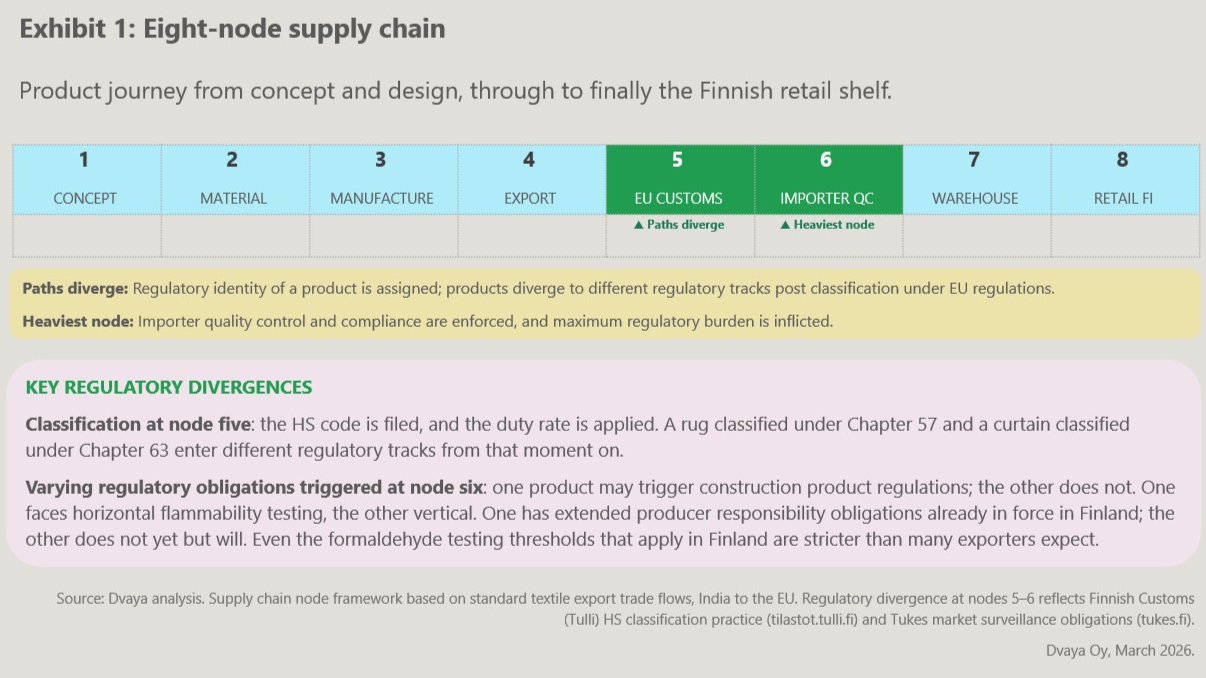
For the first four nodes, the paths are broadly similar. Both products are subject to REACH chemical safety requirements from the raw material stage. Both require standard export documentation. The regulatory identity of each product has not yet been formally assigned. That changes at node five: Finnish Customs and node six: importer quality control and compliance are where the divergence is sharpest.
The HS code is not a bureaucratic formality, it is the regulatory identity of a product, and it shapes everything that follows in the supply chain.
Where the rules separate
The specific obligations that diverge between even closely related product categories are numerous. For rugs and curtains entering Finland, the differences span duty treatment, safety standards, construction product scope, flammability testing methods, producer responsibility timelines, and anti-dumping exposure.
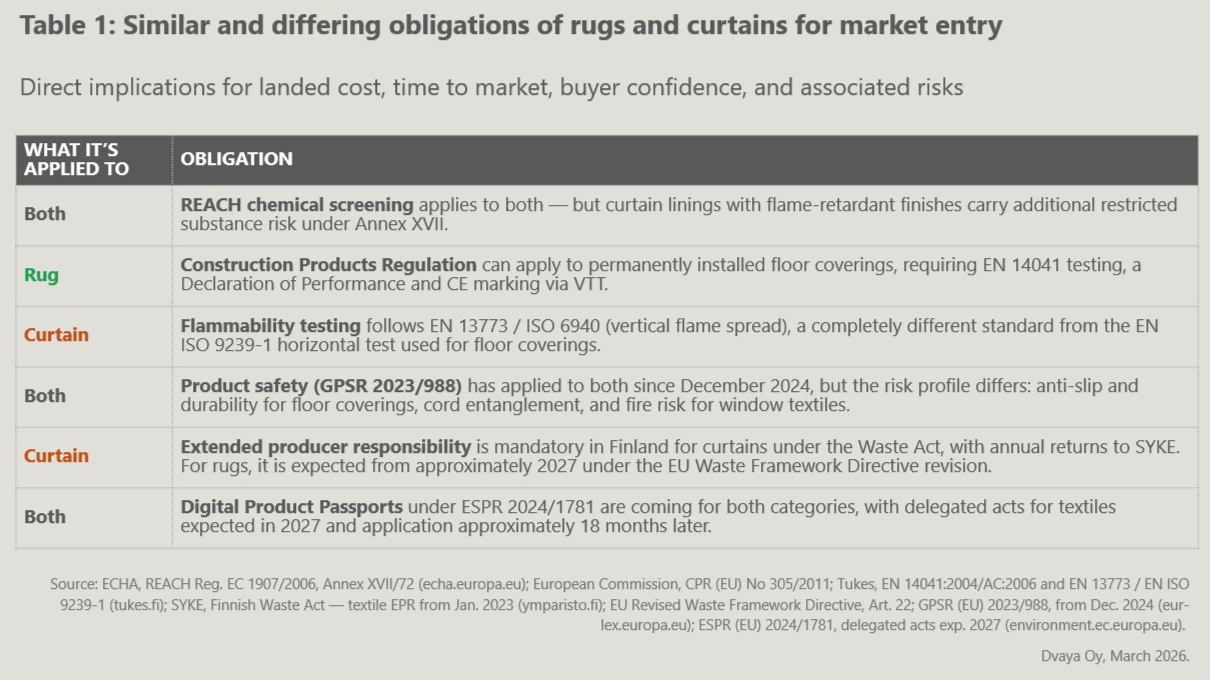
These are not obscure regulatory footnotes. Each one has direct implications for landed cost, time to market, buyer confidence, and the risk of a product being stopped at the border or pulled from a Finnish shelf. And this is just one pair of products. The pattern repeats, with different specifics, across every product category that moves from India into the EU.
Pricing waterfall: FOB to Finnish shelf
Most Indian exporters model their European pricing on FOB cost plus freight plus duty. That model misses out on layers that materially affect whether a product is competitive on a Finnish shelf.
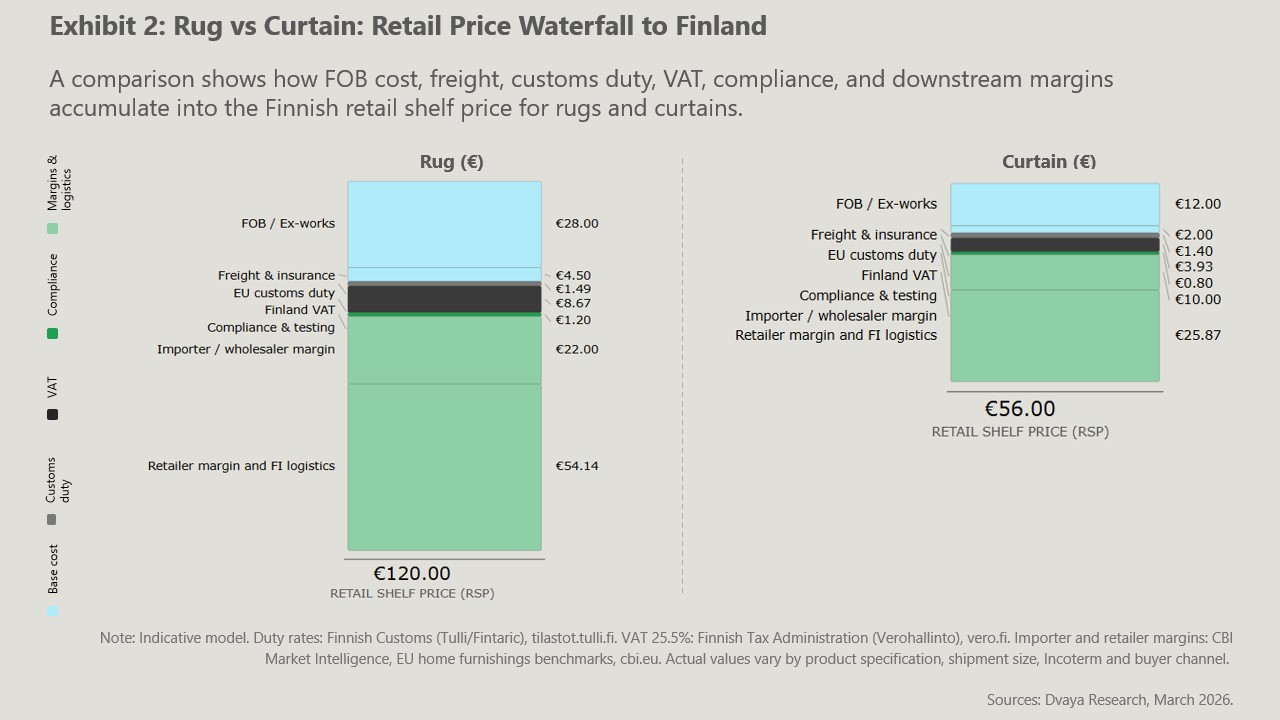
Two things stand out. First, despite curtains facing a structurally higher duty rate, the absolute duty cost in euros is nearly identical at these price points because rugs are more expensive at FOB. The duty percentage matters less than the total landed cost arithmetic.
Second, the layers between duty and shelf price- VAT cashflow, compliance testing, importer margins, Finnish logistics- collectively account for more than double the combined cost of freight and duty. These are the layers most Indian exporters do not model for, and they determine whether a product is competitive on a Finnish shelf.
The EU–India FTA moment
The EU–India FTA, when concluded, will change the economics of both categories. Duty rates will compress. But the degree of benefit will depend on which product-specific obligations a supply chain has already prepared for.
Finnish retailers and importers conducting due diligence under the EU’s Corporate Sustainability Due Diligence Directive and safety risk assessments under GPSR are increasingly asking for documentation that goes well beyond what a standard export transaction produces. Correct HS classifications backed by binding rulings, accredited test reports, producer responsibility registrations, and supply chain traceability are the markers of a supplier that is ready to move when market conditions shift.
The exporters who will benefit most from an FTA are not those who wait for it. They are those who have already built the compliance architecture to act on it the day it takes effect.
How Dvaya can support your product journey
The rug-and-curtain example illustrates a broader truth about exporting into the EU and into Finland specifically. Even products that appear similar; made from the same fibres, by the same workforce, shipped from the same port, face distinct regulatory identities, distinct compliance costs, and distinct market entry requirements.
This complexity is not a barrier. It is a navigation problem. And navigation problems are solved by understanding the terrain before you move.
The journey from an Indian factory to a Finnish shelf is a multi-layered regulatory and commercial navigation challenge. Dvaya positions itself between Indian exporters, Finnish importers, and bilateral trade intermediaries at precisely the points where that complexity is highest.
At the product entry stage, we help exporters map the specific compliance obligations their category carries: from HS classification and duty treatment to REACH, GPSR, and EPR registrations. We model the full landed cost architecture, so pricing decisions are built on what reaches the shelf, not just FOB plus freight.
At the market access stage, we identify Finnish and EU partners: importers, distributors, and buyers, who are commercially aligned and operationally equipped to manage product-specific compliance requirements. We provide support with partner validation, commercial structuring, and implementation so that relationships are built on solid operational ground.
In the wake of the India-EU FTA, we aim to help exporters build the compliance and traceability architecture now, so they are positioned to move when tariff conditions shift.
Author(s):
Ishita Jain, Strategic Partner
