
Designing an India-Finland Skills Corridor: A Practical Model for Blue-Grey Collar Mobility
By Swarnakshi Luhach
Finland's discussion of the labour market is entering a more practical phase. The country still requires specialists, students, and entrepreneurs. However, some of the most pressing labour issues are arising in sectors such as care, industrial work, technical operations, construction, logistics, and support services. These roles are essential for maintaining daily operations. They also highlight the challenges surrounding migration policy, employer readiness, language learning, vocational standards, and integration.
In this regard, India is increasingly relevant. It has a young workforce, a large skilling ecosystem and a growing policy interest in global labour mobility. Finland, meanwhile, has demographic pressure, selective labour shortages and an active Talent Boost programme for 2023–2027 focused on attraction, residence permit processes, retention and prevention of work-based exploitation.
However, the India-Finland opportunity should not be viewed merely as a recruitment story. The true value lies not in the movement itself but in the preparedness.
Why a corridor model is needed
A recruitment transaction usually begins with a vacancy and ends with a placement. That is too narrow for blue- and grey-collar mobility. A skills corridor must begin earlier and continue longer. It must answer questions that sit across both countries:
• Can the Indian candidate do the job expected in Finland?
• Can the Finnish employer absorb, supervise, and retain the worker?
• Can training and prior experience be mapped to Finnish standards?
• Can language preparation be specified honestly for the role and worksite?
• Can housing, transport, and onboarding be arranged before arrival?
• Can the worker access independent help if the employment relationship becomes unsafe?
• Can outcomes be monitored after placement, not only at the visa stage?
These are operational questions, but they are also trust questions. They determine whether mobility becomes a durable labour-market solution or another source of friction.
The case for a governed approach is strengthened by the data. In 2025, people aged 65 or over made up 23.8% of Finland’s population and the demographic dependency ratio stood at 61.6. [4] The OECD reports that Finland’s native-born working-age population fell by about 10% between 2010 and 2023, while the foreign-born share of the working-age population rose from 6.2% to 13.6%. [5]
Yet the labour market is also selective. Finland received 11,324 applications for first work-based residence permits in 2025, about 25% fewer than in 2024. The Finnish Immigration Service attributed the fall mainly to weak economic development, employer uncertainty and high unemployment. [6]
This means a corridor cannot be broad and vague. It must be occupation-specific and tied to verified demand.
From a mobility agreement to a governed corridor
The 2026 India–Finland partnership is the right enabling layer. It recognizes mobility by skilled workers, specialists and young professionals, and it gives both governments a platform for coordinated implementation. [1] The parallel ministerial discussion goes further by pointing to institutional partnerships among training systems, industry, and government. [2]
But an agreement is not evidence of occupation-level demand, and it does not remove Finnish residence-permit, qualification, employment-law or occupational-safety requirements. Its value will depend on what is built beneath it: named occupations, named employers, a skills-mapping method, a language pathway, a worker-protection protocol and post-arrival accountability.
Let’s talk numbers: A look at the economic opportunity and volumes
The viable occupations identified above do not, by themselves, quantify what a successful corridor could unlock. A defensible business case requires structural demand, current migration capacity and corridor-serviceable volume. They must not be collapsed into a single headline, i.e., shortage.
The strongest structural anchor is technology industries. Technology Industries of Finland estimates that the sector will need 130,000 new skilled workers over the next decade, including around 50,000 with vocational education with annual averages of about 13,000 and 5,000 respectively.[19] These are replacement-and-growth needs, not open vacancies or an India quota. Even so, a base industrial intake of 450 workers a year would cover only 9% of the sector’s average vocational need.
Current permit flow provides a second reality check. Finland received 11,324 applications for first work-based residence permits in 2025.[6] From January to May 2026, applications rose 16% year on year to 6,156, partly because of recruitment for shipbuilding, data-centre and other industrial projects; the Finnish Immigration Service forecasts 11,000–13,000 applications in 2026 and 12,000–14,000 in 2027.[22] Against the 12,000 midpoint of the 2026 forecast, corridor volumes of 300, 750 and 1,500 new placements would be numerically equivalent to 2.5%, 6.3% and 12.5% of annual application flow. At the upper end, the corridor would materially reshape Finland’s present inflow and should not be attempted before verified demand and retention data justify it.
Near-term sector signals are uneven. Finland issued 8,384 first work-based permits in 2025, 24% fewer than in 2024; permits in social welfare and health care fell 81%, while construction fell 24%.[23] This is why structural need must not be presented as current recruitable demand. Migri identifies Indian citizens as the largest work-permit applicant group in 2025 but does not give an India-specific total in its public release.[6] The corridor’s first dashboard must therefore establish the missing baseline: Indian applications, positive decisions, arrivals, occupation, wage and 12-month retention.
A minimum euro value can be calculated from Finland’s published median monthly pay of €4,057 for process operators and €3,154 for practical nurses.[20][21] A 60/40 occupational mix produces an illustrative gross salary of €3,696 per month, or €44,350 per worker-year. This is not a GDP-impact estimate. It is a transparent floor: direct labour income generated by filled jobs, before employer on-costs, overtime, taxes, household spending, remittances, family employment or the production and service capacity preserved by reducing vacancies.
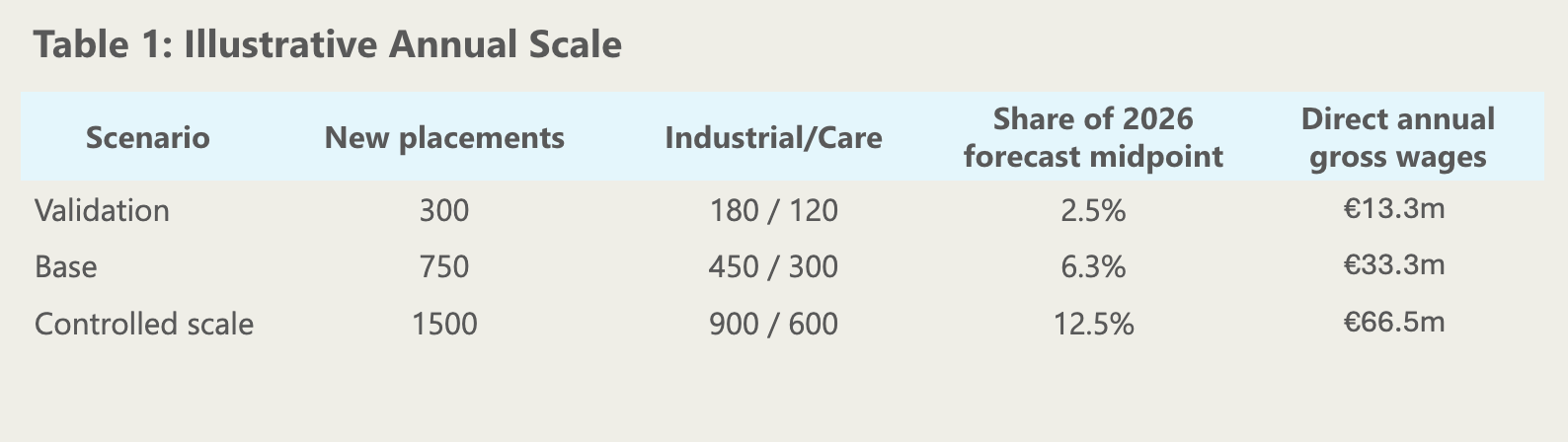
Potential annual recruitment and earnings through the India–Finland skills corridor.
Calculation: placements × €44,350. The 60/40 sector split and salary blend are planning assumptions, not a forecast or a promised wage. Care volumes remain conditional on lawful role design, qualification recognition, language readiness, ethical recruitment and signed employer demand.
A five-year realisation case makes the compounding value visible. A governed ramp of 30, 150, 300, 500 and 750 new placements, with 80% of the active stock remaining employed from one year to the next, produces 1,730 placements, about 2,926 worker-years and approximately €130 million in cumulative gross wage income at today’s occupational medians. By year five, about 1,431 workers remain active and their annualized gross payroll is approximately €63 million. This model should be rerun quarterly with signed vacancies, actual wages, permit approvals, arrivals and retention.
That is the economic case for unlocking the corridor. Finland gains productive capacity and a broader earned-income tax base; India gains access to higher-productivity employment, remittance potential and demand for credible skills preparation. Both countries can develop a standards market in assessment, language, qualification bridging, onboarding and retention support. These secondary gains are deliberately not monetised here, avoiding double counting and preserving the distinction between a scenario and measured impact.
A case-look at how Denmark–India agreement operationalises labour mobility: what transfers and what does not
The Denmark–India experience is useful as a corollary because it shows how bilateral architecture shapes up. India’s 2009 Cabinet-approved labour-mobility memorandum with Denmark already envisaged orderly migration, equal treatment, direct links between Danish employers and Indian recruiters, worker welfare, dispute settlement and a joint working group. [8] In 2022, the two countries added a declaration of intent on migration and mobility and an agreement on skills development, vocational education and entrepreneurship. [9] A broader Mobility and Migration Partnership Agreement followed in 2024. [10]
The design details matter. The European Commission’s account of the 2024 agreement emphasizes short-term employment, return cooperation and the importance of Danish language and cultural preparation. [10] Denmark’s health-sector policy discussion also links international recruitment with authorization pathways, education cooperation and the ethical risk of weakening source-country health systems. [13]
Denmark’s model gained a more operational layer in September 2026. Parliament adopted a new collective agreement-based business scheme, scheduled to take effect on 1 January 2027. It will allow certified employers covered by qualifying collective agreements to recruit nationals of 16 selected countries, including India, for covered jobs meeting a minimum annual salary of DKK 322,000 at the 2026 level. Employer eligibility includes at least 10 full-time employees in Denmark and two years of operation. [11] [12] This is not an India-specific bilateral channel, nor yet evidence of employment or retention outcomes. It nevertheless shows how wider access can be paired with employer certification, collective-agreement coverage and enforceable labour standards.
The transferable lesson is not that Denmark has solved labour mobility. It is that a bilateral agreement is only the governance shell. Delivery still requires occupation selection, trusted public and employer channels, no-fee recruitment, language preparation, authorisation or qualification pathways, and follow-through after arrival.
The comparison also has limits. Denmark and Finland differ in permit rules, welfare and employer structures, language thresholds and care-sector qualification systems. The Danish pathway, therefore, may be used as a design prompt and risk checklist and not as a plug-and-play template.
The Dvaya Mobility Readiness Model
Dvaya’s earlier analysis argued that the policy discussion should move from broad attraction to implementable Talent Bridge pathways. [7]
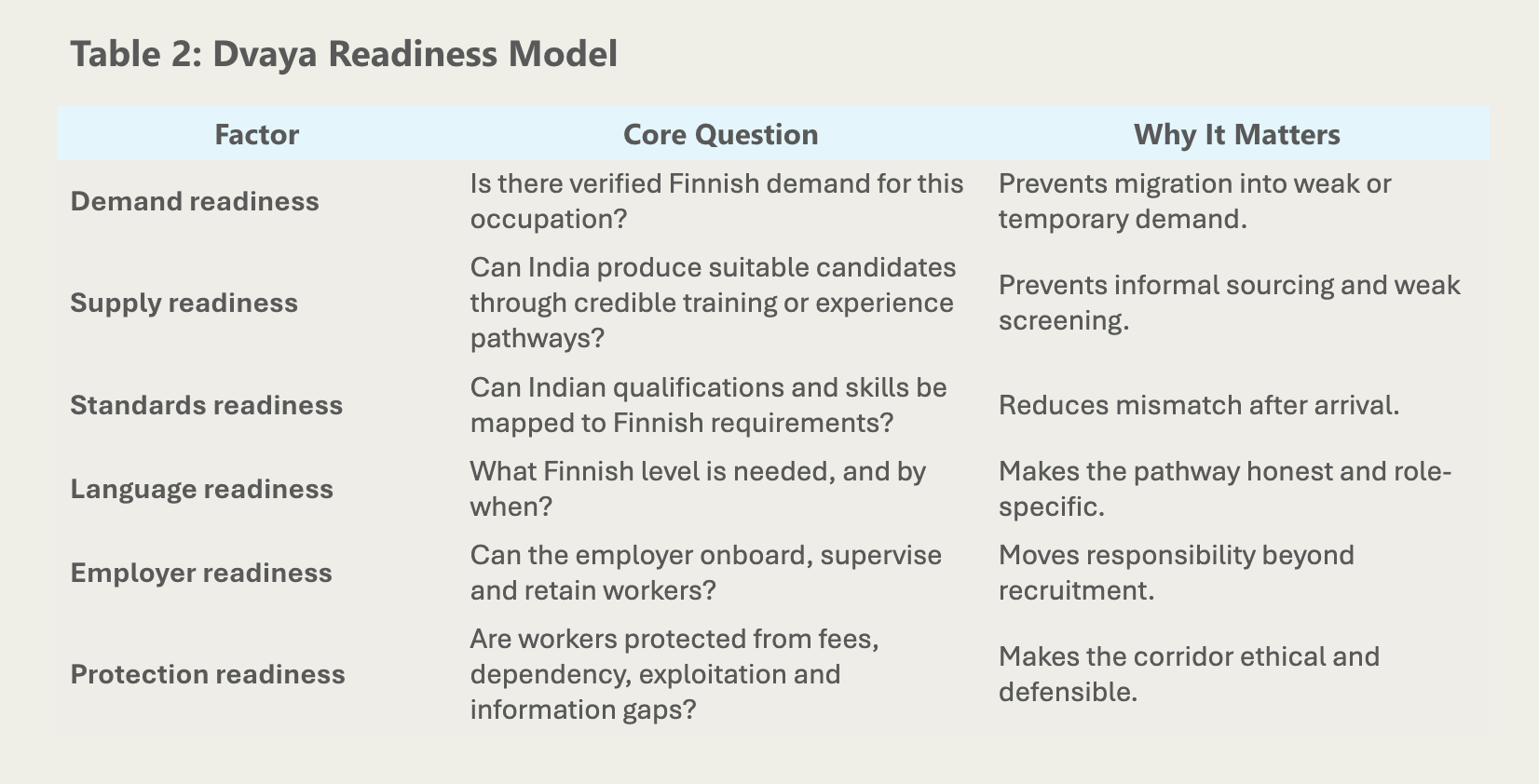
A practical India–Finland corridor can be assessed through six readiness factors.
Each occupation can be scored from 0 (not ready) to 2 (ready) on every factor. A high total is not enough if protection, standards or employer readiness scores zero: those are pilot-stopping gaps, not issues to solve after arrival.
Where the first pilots should begin
Finland’s 2025 labour-shortage decree is a useful recent signal: it listed metal-processing operators, nurses and practical nurses among occupations with nationwide labour-availability problems. But the decree entered into force on 11 June 2025 and was specified to remain in force for one year. It should therefore not be presented as a current 2026 demand forecast. [14]
Pilot selection must now combine current employer evidence with the six-factor readiness assessment. Three types of pathways merit structured exploration.
1. Industrial process operators: the strongest feasibility candidate
Industrial process roles, especially in metals and advanced manufacturing, are a credible first candidate for feasibility work. The tasks can often be described through observable workplace competencies, safety requirements and production standards. Compared with regulated care roles, this can make assessment and supervised onboarding easier to design.
For India, the supply-side opportunity is substantial but must be filtered for quality and role fit. As of July 2025, India reported 14,615 Industrial Training Institutes: 3,316 government and 11,299 private institutions. The same release emphasized periodic standards review, industry consultation, and data-driven grading that are useful building blocks for selecting, rather than merely counting training partners. [15]
A pilot could begin with 20–30 candidates, three to five Finnish employers, one Indian training cluster and one clearly defined role family. Before recruitment, employers should validate the task standard, shift pattern, safety vocabulary, wage framework, housing geography and 12–18-month demand horizon. The first goal is proof of fit, not scale.
2. Care pathways: strategic, but slower
Care remains strategically important, but it is harder to operationalise in the corridor. It combines patient safety, language, emotional labour, protected professional titles and regulated progression. Finland’s current licensing authority, Lupa- ja valvontavirasto, separates language sufficiency, recognition, adaptation periods and aptitude tests within the route for professionals trained abroad. [16]
A staged pathway may be possible for candidates with relevant care or nursing backgrounds, but only where the entry role is legally valid and accurately described. A support role must not become a permanent deskilling trap. Before departure, candidates should know the job title, pay, duties, language target, recognition steps, expected timeline, who pays for bridging education and what happens if progression is delayed.
Recruitment fees should not be transferred to workers, directly or indirectly, in line with the ILO’s fair-recruitment principles. [17] Health-worker recruitment should also be tested against the WHO Global Code, including the effect on source-country health systems and the need for mutual benefit. [18]
Municipalities, wellbeing services counties, care providers, vocational institutions, the licensing authority and worker representatives should therefore be at the table before a care pilot is announced. This pathway is slower, but strategically important if it protects both patients and workers.
3. Construction, green retrofit and logistics: watchlist sectors
Construction, green retrofit and logistics may become relevant. The March 2026 India–Finland ministerial discussion specifically referred to construction, green technologies and advanced manufacturing as areas of complementarity. [2]
These sectors should be approached carefully. Construction is cyclical and can involve subcontracting chains, site-safety requirements, regional variation and housing challenges. Logistics and facility support may be easier to train for, but wages can be lower and worker vulnerability can be higher.
They should move into pilot design only when employers commit to stable contracts, transparent deductions, collective-agreement compliance, safe housing arrangements, role-specific onboarding, independent grievance channels and post-arrival monitoring.
From bilateral intent to one governed pilot
The 2026 India–Finland mobility partnership creates a timely policy window. The right response is not a large recruitment announcement. It is one governed pilot with an occupation, employer group and training cluster that can be named and tested.
A pilot should not launch until it has:
• verified employer demand with a 12–18-month horizon and a defined Finnish task standard;
• candidate assessment and a documented mapping between Indian training or experience and Finnish requirements;
• a role-specific language plan, with responsibilities, milestones and funded learning time;
• written safeguards on recruitment fees, wages, deductions, housing, information, grievance access and job loss; and
• a shared dashboard for arrival, onboarding, retention, progression, complaints and corrective action.
Denmark’s experience shows how bilateral architecture can progress toward an employer-gated operating mechanism, while reinforcing the central point: agreements enable corridors; verified institutions and employers operate them. Finland and India now have the framework. The next test is whether institutions and employers can turn it into a small, transparent and defensible pathway that works for both labour markets and for the people who move between them.
References
[3] Ministry of Economic Affairs and Employment of Finland, “Talent Boost programme.”
[4] Statistics Finland, “Population structure,” 2025 key figures, updated 29 May 2026.
[5] OECD, OECD Economic Surveys: Finland 2025, p. 62.
[7] Dvaya, “Beyond Talent Boost: Can India Help Solve Finland’s Labour Market Crisis?”, 1 April 2025.
[9] Ministry of Foreign Affairs of Denmark, “India–Denmark Joint Statement,” 3 May 2022.
[19] Technology Industries of Finland, “Skilled Workforce,” updated 6 May 2026.
Author(s):
Swarnakshi Luhach, Principal
