
Tariff Zero Isn’t the Win: Why the EU’s Textile Rules Are Becoming the Real Barrier for Indian Exporters
By Swarnakshi Luhach
The India-EU Free Trade Agreement is expected to boost Indian textile and apparel exports by removing tariffs of 9–12% that have limited competitiveness against countries like Bangladesh and Vietnam. However, focusing solely on tariffs may miss significant shifts in European markets.
The EU is developing a regulatory framework that emphasises compliance, traceability, and accountability regarding a product's lifecycle. Successful sales in Europe now rely on proof of material origin, recyclability, and sustainability, indicating a shift from customs duties to environmental responsibility, which carries economic implications as well.
Sustainability Regulation Is Resculpting Market Access
Four policy shifts are converging to redefine supplier eligibility:
Extended Producer Responsibility (EPR) schemes are mandated under the revised Waste Framework Directive. Producers, including non-EU entities, placing products on the EU market, must finance the collection, sorting, reuse, and recycling of their products at end-of-life.
Eco-modulated fees mean that products designed for durability, repairability, and recyclability incur lower compliance costs, while low-durability products incur higher fees. This mechanism also means that Indian manufacturers who can demonstrate these abilities will enjoy structurally lower compliance costs for their European buyers.
Digital Product Passports (DPP) will require machine-readable lifecycle data, allowing authorities and buyers to verify sustainability attributes. For Indian exporters, this means implementing an end-to-end data infrastructure, as most of India's 45 million textile workers are in MSMEs, and informal value chains lack such systems.
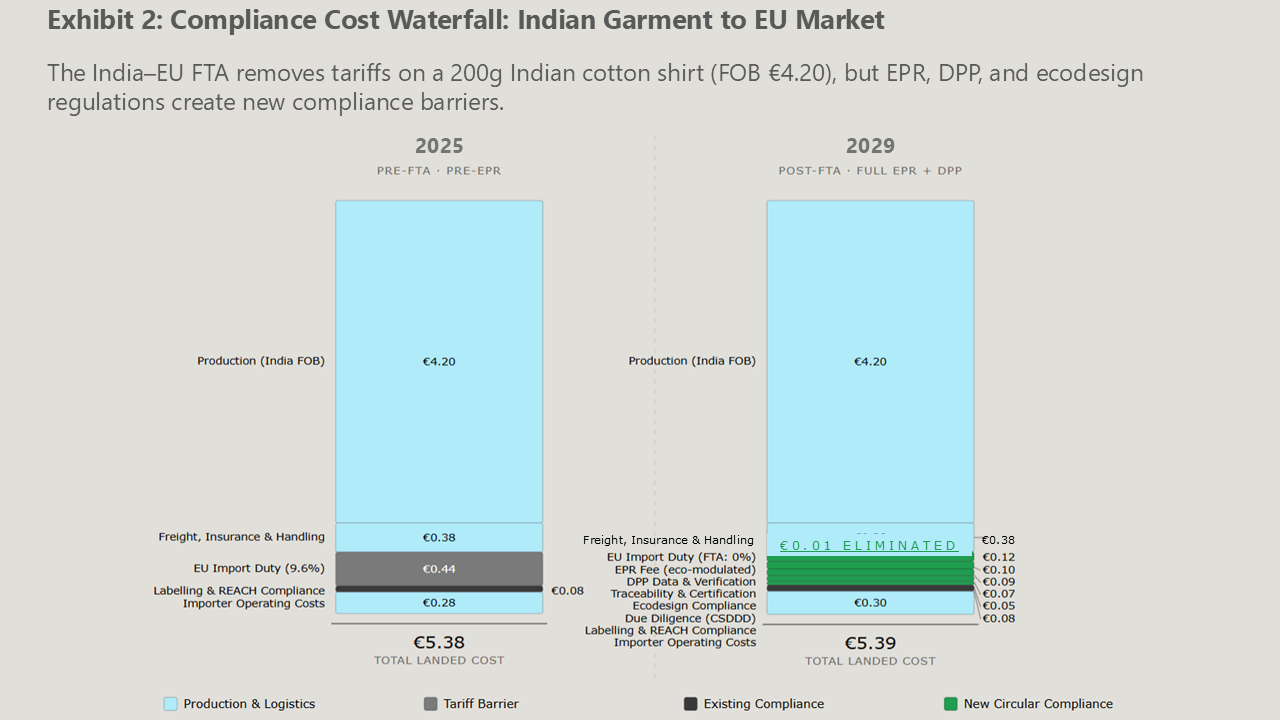
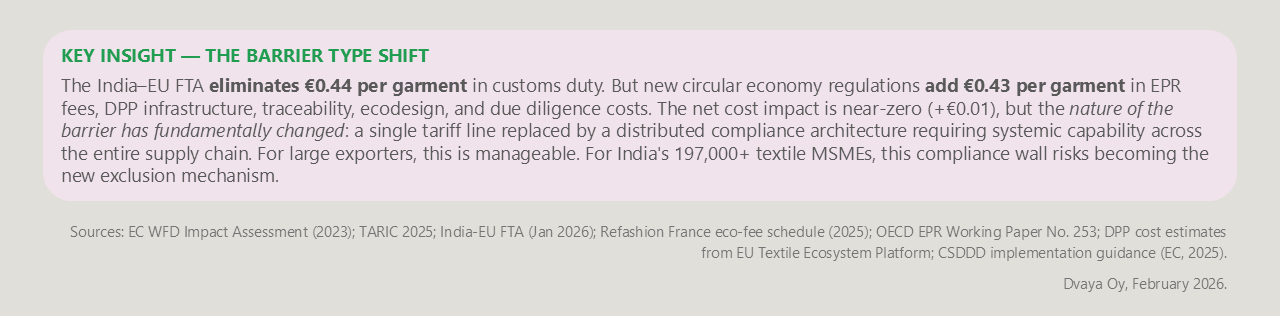
The India–EU FTA allows zero-duty access for Indian textiles to the EU’s €263.5 billion import market. Indian textile exports, valued at $7.6 billion in FY 2024–25, previously faced tariffs of 9–12%, which the FTA eliminates. This is expected to boost apparel exports to Europe, though compliance with new EPR, DPP, and eco-design requirements may pose new challenges.
EPR Links Product Design in India to Costs in Europe
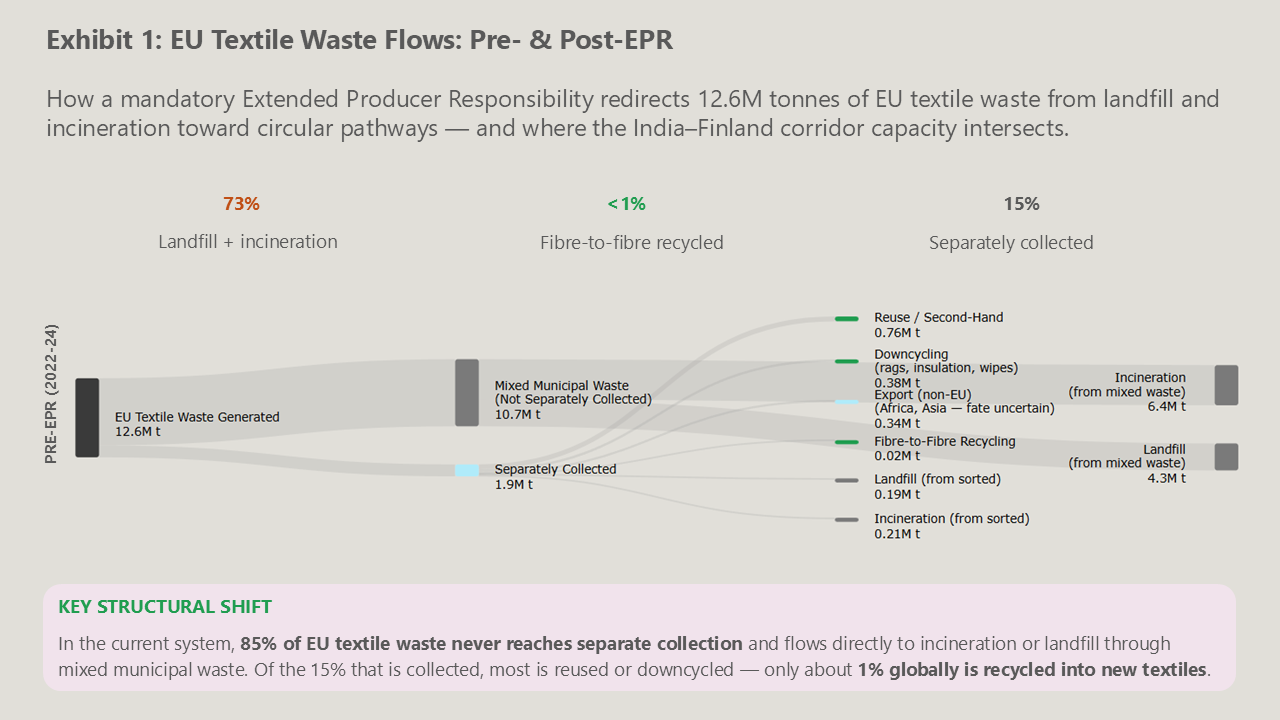
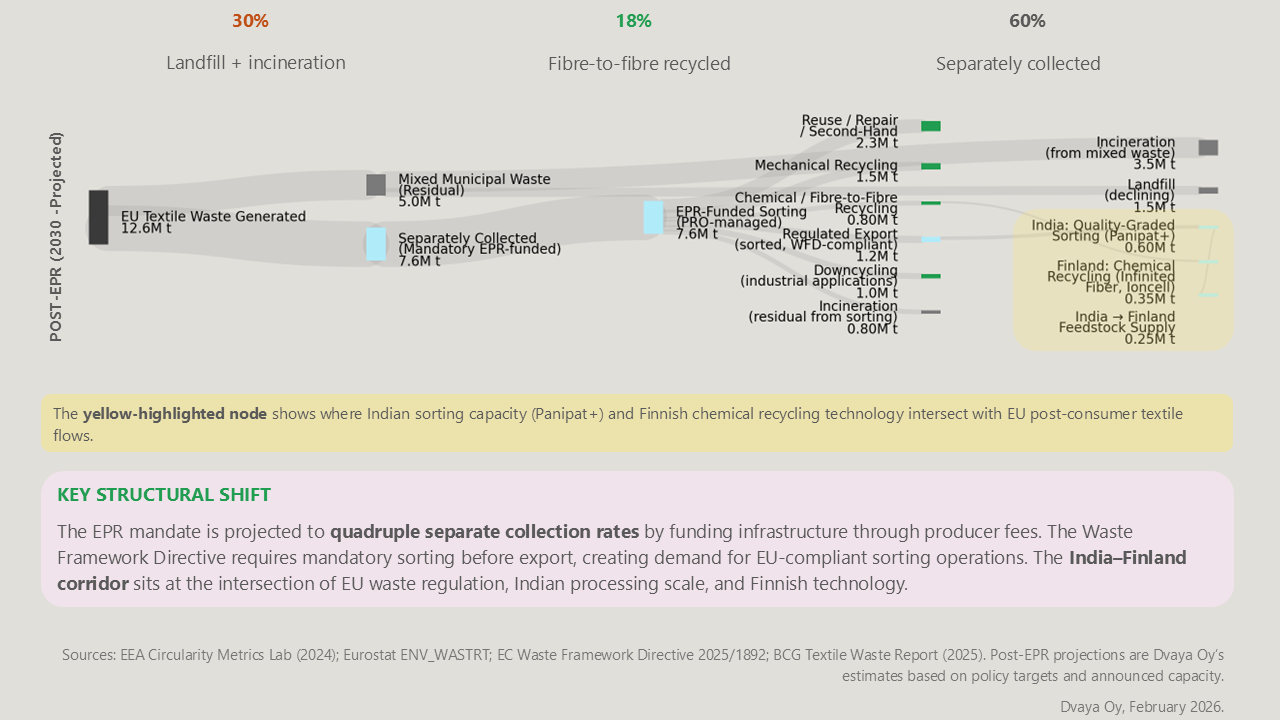
Extended Producer Responsibility fundamentally alters the economics of supply chains. Under EPR, the entity placing products on the EU market must finance their ecosystem impacts. This cost exposure is not uniform; it is structured to incentivise better design.
Durable, recyclable products may attract lower fees. Mixed fibres, low recyclability, or short lifecycle garments may attract higher prices. This creates a new commercial logic: European buyers have a financial incentive to favour suppliers whose products reduce their EPR burden.
From Sustainability Claims to Data Infrastructure: New Friction Points
The regulatory shift from tariff-based to compliance-based market access creates multiple implementation gaps that are particularly acute in the India–EU corridor.
Traceability: The DPP needs verified information on material composition, origin, and environmental impact throughout the supply chain. India's textile industry is fragmented, with under 5% of over 197,000 businesses equipped with digital tools for DPP-compliant data, creating challenges in effective coordination.
Sorting and Recycling Quality: Panipat is Asia’s largest textile recycling hub, processing over 100,000 tonnes of textile waste annually. Most output consists of low-value, downcycled products due to inadequate fibre identification technology, mixed-fibre blends that complicate recycling, and major wastewater issues, with 80% discharged untreated.
EPR Compliance Infrastructure: Each EU Member State will set up its EPR scheme, requiring Indian exporters to register with various Producer Responsibility Organisations (PRO) with differing fees and reporting requirements. There is no centralised compliance for non-EU producers, creating a coordination challenge that is more informational than capital-intensive.
Environmental and Social Compliance: The EU’s Trade and Sustainable Development chapter mandates commitments to environmental and labour standards. Panipat alone has over 400 registered dyeing units and 200 illegal ones, with $57 million in fines for violations. To meet EU standards, India must improve working conditions and effluent treatment.
Emerging Opportunity: Compliance Capability as a New Export Advantage
As EPR schemes mature and DPPs come into force, European buyers will increasingly prioritise suppliers who can reduce compliance complexity, lower lifecycle costs, and provide reliable product data. This introduces a new axis of competitiveness alongside price, quality, and delivery reliability.
For Indian exporters, particularly in MSME-dense clusters, several opportunity pathways are emerging.
Compliance-ready manufacturing as a differentiator
Exporters offering standardised data and compliance documentation will ease burdens for European buyers and become preferred partners. Compliance readiness may signal market value, akin to quality certifications.Product redesign aligned with eco-modulation incentives
EPR fee structures increasingly reward durability, recyclability, and material simplicity. Indian manufacturers that align product design with eco-modulation criteria can reduce lifecycle costs for buyers and strengthen long-term sourcing relationships.This creates incentives for mono-material design, improved durability and repairability, and recyclable fibre compositions, and the reduction of complex blends.
Cluster-level data and traceability infrastructure
India’s textile ecosystem is organised around clusters, and compliance requirements highlight the importance of shared data standards and documentation practices at the cluster level. Developing common templates for product data, material composition, and traceability can lower per-firm compliance costs and improve onboarding into European supply chains.Integration into circular material value chains
Europe’s push for recycled content and material recovery is increasing demand for traceable secondary fibres and compliant recycling processes. India already possesses large-scale textile recovery and recycling capacity. The transition creates opportunities to upgrade sorting and grading protocols, improve traceability of recovered fibres, move from downcycling toward higher-value recycling streams, and participate in circular textile supply chains.Compliance services and ecosystem specialisation
As regulatory complexity rises, new specialisation niches are emerging around compliance documentation, traceability systems, lifecycle data management, and sustainability verification. These ecosystem roles will become increasingly necessary to support exporters navigating EU regulatory frameworks.
Why Finland Matters in This Transition
Finland’s relevance to this transition does not lie in market scale. It lies in operational maturity.
Nordic countries have been early adopters of circular economy frameworks, municipal textile collection systems, and material recovery governance models. Finland’s ecosystem includes advanced sorting technologies, circular textile innovation initiatives, and established producer responsibility practices.
As EU member states scale textile collection and recycling systems, these operational models are becoming increasingly relevant across Europe.
For Indian exporters and recycling ecosystems, Finland offers:
practical insight into how circular textile systems function at municipal and industry levels
examples of sorting, grading, and recovery protocols aligned with EU policy objectives
early experience in implementing extended producer responsibility frameworks
exposure to circular material innovation and secondary fibre markets
In this context, Finland serves as a destination market as well as a reference environment for understanding how Europe’s circular textile transition is being operationalised.
As regulatory expectations tighten across the EU, familiarity with these operational systems may become a strategic advantage for firms seeking long-term participation in European value chains.
Author(s):
Swarnakshi Luhach, Principal
